
Best Practices for Safe Forklift Operation: Comprehensive Forklift Safety Guidelines and Operator Training
Written By : Darko
Safe forklift operation means using material handling equipment in a way that prevents injury, property damage and operational downtime by combining correct procedures, competent operators and maintained vehicles. This guide explains how operator behaviour, load management and workplace systems work together to reduce risks, showing specific practices that improve stability, minimise collisions and ensure WHS compliance. Many workplaces face preventable incidents caused by incorrect loading, poor pre-start inspections and inadequate training; this article provides practical steps, checklists and regulatory summaries aimed at employers and operators in Australia. You will learn essential operator rules, a step-by-step daily pre-operation inspection process, the legal framework for training in Australia, accident-prevention systems and technologies, pedestrian protection measures, and employer duties under SafeWork NSW and WHS legislation. Each section includes actionable lists and tables for quick reference, plus guidance on when to escalate faults for professional servicing or equipment replacement. Understanding these elements prepares site managers and operators to implement safer systems and to choose the right forklifts and services for their context.
What Are the Essential Forklift Safety Guidelines Every Operator Must Follow?
Essential forklift safety guidelines define the core behaviours and controls that prevent the majority of incidents by addressing human, machine and environmental factors; these rules work because they reduce operator error, preserve vehicle stability and protect pedestrians. Operators should follow a small set of high-impact practices, using seatbelts and restraints, respecting rated load limits, maintaining safe speed and clear sightlines, performing pre-start checks and communicating effectively, because each practice directly reduces specific failure modes such as tip-overs and collisions.
The following list presents the top rules in a concise format designed for quick workplace training and featured-snippet style recall, and the subsequent table summarises rules by component to assist checklist creation. Apply these guidelines consistently and integrate them into site induction and daily routines to create predictable, safe behaviours that reduce incidents and support compliance with WHS duties.
The top rules below provide immediate, actionable direction for operators and supervisors and introduce the load and stability principles covered next.
What Are the Top 5 Rules of Forklift Safety?
The five most critical rules of forklift safety set immediate expectations for safe operation and incident avoidance. First, always wear the seatbelt and use operator restraints to keep the operator within the protective envelope of the vehicle; this prevents ejection during tip-overs. Second, know and never exceed the rated load capacity for the truck and attach the correct load-centre adjustments; this preserves the stability triangle and prevents tip-overs. Third, maintain safe travel speed and stopping distance, especially in congested or wet environments; reduced speed improves reaction time. Fourth, maintain clear sightlines and use spotters when visibility is restricted; communication reduces collisions with pedestrians and structures. Fifth, perform a complete pre-start inspection each shift to catch faults early and remove unsafe trucks from service.
These rules form the behavioural baseline that supports the load-capacity and stability detail discussed next.
How Do Load Capacity and Stability Affect Safe Forklift Operation?
Load capacity and stability govern whether a forklift can safely lift and transport a load by defining limits based on the truck’s centre of gravity, the load centre and the stability triangle; understanding these elements prevents tip-overs and loss of control. The rated capacity on the data plate assumes a specific load centre (commonly 500 mm); shifting the load forward or lifting it too high increases the moment arm and effectively reduces safe capacity, so correct load placement and securing are essential. Practical measures include using load charts, checking that loads are evenly stacked, keeping forks low during travel, and reducing lift height on inclines. For unstable or oversized items, use appropriate attachments or alternative lifting methods and ensure operator training covers telehandler and specialised equipment differences. Correct load management complements operator rules by translating capacity limits into everyday handling choices that lower risk.
Different forklift types (electric, diesel, telehandler, walkie stacker) have distinct stability characteristics, so familiarisation with the specific vehicle on-site is necessary before operation.
| Component | What to check | Acceptable condition / Action if fault found |
|---|---|---|
| Seatbelt & restraints | Integrity and function | Clean, latched securely; tag out if belt frayed or latch fails |
| Rating plate & load chart | Correct capacity for load centre | Data plate legible; if missing, remove truck from service |
| Forks & carriage | Cracks, wear, alignment | No cracks, <10% wear; replace or repair if damaged |
| Mast & tilt mechanism | Smooth operation, no bending | Operates without binding; service if jerky or noisy |
| Tyres | Tread, cuts, pressure (if pneumatic) | No major cuts, adequate pressure; replace or inflate as required |
This table summarises essential component checks that underpin the top rules and pre-operation checklist that follows.
How Should Forklift Operators Complete Daily Pre-Operation Checks?
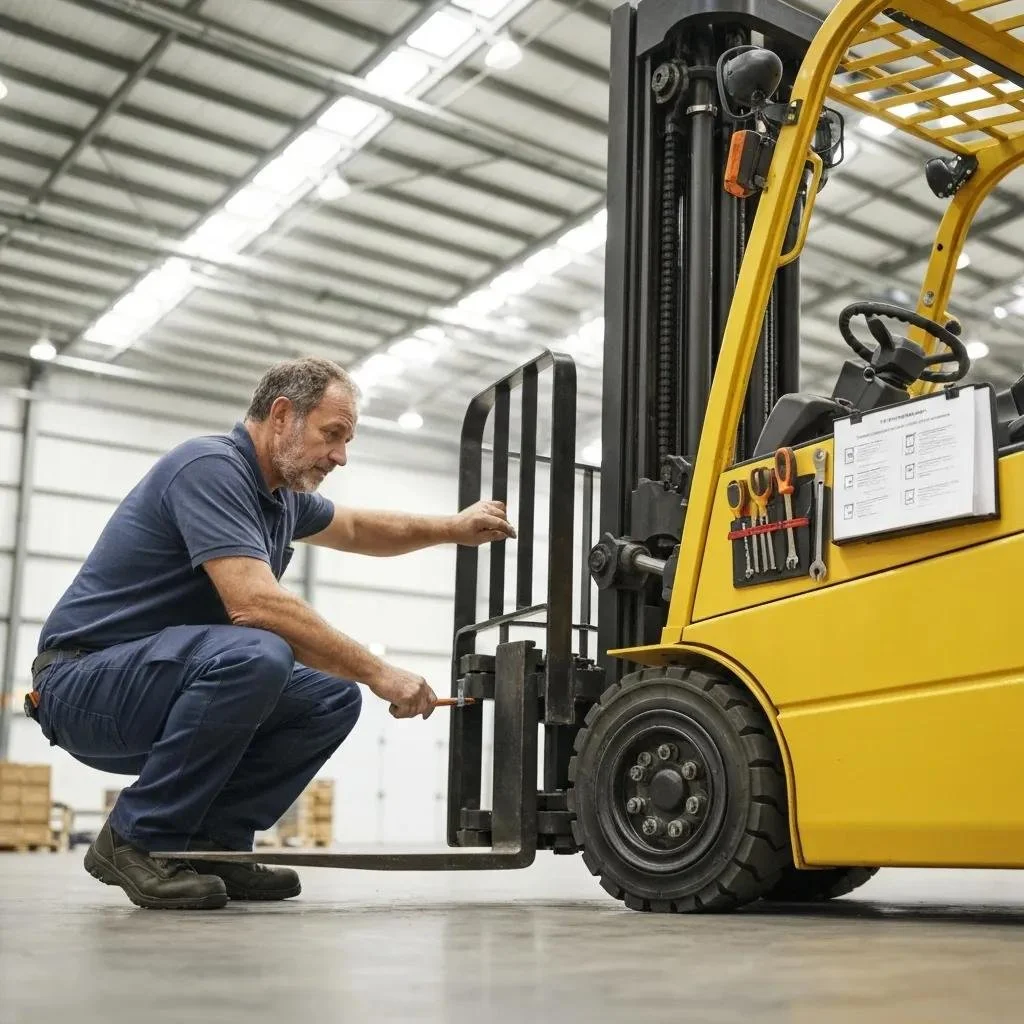
Daily pre-operation checks are a predictable sequence of visual and operational tests that identify hazards before they escalate into incidents; completing these checks reduces in-shift failures and ensures trucks are safe for service. A complete pre-start routine covers visual items (forks, mast, tyres, fluid leaks), operational controls (brakes, steering, horn, lights), energy systems (battery charge, fuel levels) and safety devices (seatbelt, warning alarms). Operators should document checks on a standard form, immediately tag out unsafe equipment and notify supervisors so servicing can be scheduled; record-keeping creates traceability and demonstrates compliance with WHS obligations.
Completing these steps each shift forms a clear gateway to safe operation and leads into the more detailed checklist components listed next.
The grouped daily inspection checklist focuses on visual, operational and safety items.
Visual checks: inspect forks, mast, carriage, overhead guard and counterweight for damage or deformation.
Operational tests: confirm brakes, steering, horn, lights and hydraulic functions perform smoothly.
Energy/fuel checks: verify battery state of charge, electrolyte level (where applicable) or fuel level and secure caps.
Safety devices: ensure seatbelt latches, alarms, lights and mirrors are present and functioning.
These grouped checks create a quick reference that operators can complete in sequence, and the following table provides an EAV-style mapping of typical items.
| Component | What to check | Acceptable condition / Action if fault found |
|---|---|---|
| Forks | Straightness, cracks, wear at heel | No cracks, <10% wear; remove from service if damaged |
| Tyres | Cuts, tread, inflation (pneumatic) | No major cuts, adequate tread; replace or inflate |
| Brakes | Parking and service brake performance | Hold on gradient; tag out if slipping or noisy |
| Hydraulics | Leaks, smooth lift/lower, no excessive drift | No leaks; service if noisy or slow |
| Lights & alarms | Headlights, beacons, backup alarm | All operational; replace bulbs/batteries promptly |
Mapping components to clear pass/fail criteria helps operators decide when to tag and report faults rather than continuing unsafe use; consistent record-keeping supports timely maintenance and regulatory compliance. Regularly review the checklist to include equipment-specific items for telehandlers, walkie stackers or electric forklifts to maintain relevance.
What Is Included in a Daily Forklift Inspection Checklist?
A robust daily forklift inspection checklist groups tasks into visual, operational and safety-device checks to ensure nothing is missed before operation, reducing the chance of in-shift failure and accidents. Visual checks include inspecting forks and mast for cracks or bends, checking tyres for cuts and tread wear, and scanning for fluid leaks beneath the truck; these reveal structural or service needs that require action. Operational tests confirm brakes, steering, hydraulic controls, horn, lights and steering function correctly under normal conditions; any lag or unusual noise should trigger tagging out. Safety-device checks ensure seatbelts latch, mirrors and warning beacons work, and that any installed collision-avoidance systems are functional. Using a standardised form or digital entry makes these checks repeatable and auditable, linking directly to maintenance scheduling and WHS record-keeping.
Completing these grouped checks ensures faults are caught early and leads into the process for reporting and arranging repairs described next.
How Should Operators Report Faults and Maintain Equipment Safety?
When a defect is found, operators should immediately remove the forklift from service or restrict it to essential movements only, tag it with a clear 'out of service' marker and notify a supervisor to arrange repairs; this workflow keeps unsafe trucks from being used and creates a documented chain of custody for maintenance. The typical reporting flow is: identify the fault, tag the vehicle, log the issue on the inspection form, inform the supervisor and schedule servicing with the maintenance team; emergency-critical faults such as brake failure require immediate isolation of the truck.
Retain inspection records and service history to demonstrate proactive maintenance and to identify recurring faults that may indicate a systemic problem. Preventative maintenance scheduled based on usage and inspection findings reduces unexpected breakdowns and supports longer service life for tyres, brakes and hydraulic components.
Wollongong Forklift offers maintenance and servicing options that can support workplaces when inspections identify faults or when scheduled servicing is required; the company supplies servicing for a range of material handling equipment and can advise on service intervals or help arrange preventative maintenance. Their maintenance services are positioned as a complement to operator checks, operators perform daily inspections and flag issues, and professional technicians complete repairs and scheduled servicing to maintain safe operation. Employers may use such servicing arrangements to ensure thorough inspections by qualified technicians and to access parts and repairs that fall outside on-site capabilities. Contacting a trusted supplier for servicing guidance helps ensure faults identified in daily checks are resolved promptly and in line with manufacturer specifications.
Research indicates that a successful forklift pre-operational inspection program is heavily influenced by factors such as clear guidelines, management support, adequate training, and feedback mechanisms.
Forklift Pre-Operational Inspection: Factors for Success
Forklifts are indispensable for material handling and logistics across numerous industries. However, the inherent risks associated with their operation necessitate vigilance from both operators and bystanders. A systematic pre-operational inspection involves a thorough examination of critical forklift components, including brakes, tires, steering mechanisms, hydraulics, and safety features. The purpose of pre-operational inspection is to mitigate accidents and ensure optimal performance. This study investigates the significance of pre-operational inspection in forklift maintenance and operation from the perspective of forklift operators. A survey of 52 forklift operators was conducted to identify the key drivers influencing their motivation to perform pre-operational inspections. Structural equation modelling was employed to analyse the relationships between dependent and independent variables. The findings indicated that forklift operators perceived the presence of guidelines, management support, training and certifications, and feedback mechanisms as crucial for a successful forklift inspection programme. These results were subsequently used to enhance the existing inspection training programme and to assist the organisation in identifying the factors to prioritise when implementing the programme.
Factors Influencing the Implementation of a Forklift Pre-operational Inspection Program, MML Cahigas, 2024
Why Is Forklift Operator Training and Certification Critical for Safety?
Forklift operator training and certification ensure that operators have the competency to operate industrial vehicles safely by combining theory, practical assessment and on-site familiarisation; competent operators reduce accidents and meet employer obligations under WHS law. Accredited training covers vehicle controls, load handling, stability, hazard recognition and applicable regulations; the result is operators who understand the reasons behind rules and can apply them under pressure. Employers must match training to the specific truck types used on-site, electric forklifts, diesel models, telehandlers and walkie stackers each need equipment-specific familiarisation, so training programs should include both classroom instruction and practical assessment on the exact machines present. Regular assessment and clear training records demonstrate compliance and form part of a proactive safety culture that reduces incidents and improves productivity.
Proper training also prepares operators for refresher courses and continuous learning, which the next section details in terms of timing and triggers.
What Are the Legal Requirements for Forklift Operator Training in Australia?
Legal requirements in Australia require employers to ensure workers are competent and supervised when operating equipment, which means providing training and assessment appropriate to the forklift type and workplace risks; SafeWork NSW and national WHS guidance outline these employer duties. Employers must provide information, instruction and training, ensure practical competency assessment, and maintain records of training and assessment outcomes as part of reasonable steps to control risks. Training rarely ends at a generic certificate, employers should provide on-site familiarisation with specific vehicles, loads and workplace layouts to meet site-specific hazards. Documented training, periodic assessments and supervision create the evidence trail that supports compliance with WHS obligations and demonstrates that operators were provided with appropriate instruction.
These employer duties make a case for accredited training combined with site-specific familiarisation, which leads into recommended refresher intervals discussed below.
How Often Should Operators Complete Refresher Courses and Continuous Education?
Refresher training intervals should be determined by risk, operator performance and changes in equipment or workplace conditions; a typical cadence is a formal refresher every 1–3 years with immediate retraining after incidents or observed unsafe performance. Factors increasing refresher frequency include high incident rates, changes in forklift technology (for example, introduction of telematics or anti-collision systems), new load types or altered workplace layouts. Continuous education can take the form of toolbox talks, supervised ride-alongs, and targeted competency assessments to reinforce critical behaviours between formal courses. Employers should record refresher dates and the triggers for retraining so that training becomes an active risk-control measure rather than a one-off compliance exercise.
Consistent refresher policies ensure operator competency remains aligned with evolving site risks and technology, which supports broader accident-prevention strategies.
Wollongong Forklift can assist customers by providing guidance on meeting training requirements and by connecting employers to accredited training providers; while the company does not provide training itself, it supports customers with practical advice on what to include in site familiarisation and how to document competency assessments. Employers seeking assistance can discuss their fleet mix and workplace risks with suppliers to identify appropriate training pathways and to ensure training addresses the specific truck types in use. This collaborative approach helps employers align external accredited training with internal induction and on-site assessment requirements to meet WHS expectations. Contacting a supplier for guidance is a practical next step after deciding on training needs.
How Can Forklift Accident Prevention Be Effectively Implemented in the Workplace?
Accident prevention succeeds when engineering controls, administrative systems and technology are combined to control foreseeable risks; a layered approach reduces the likelihood and severity of incidents by addressing root causes such as human error, equipment failure and environmental hazards. Key measures include designing traffic management plans with pedestrian exclusion zones, installing physical barriers and signage, using speed limits and management of vehicle routing, maintaining equipment through scheduled servicing, and applying safety technologies like proximity sensors and telematics to monitor operator behaviour. Emergency procedures and incident investigation processes turn incidents into learning opportunities that reduce recurrence.
A systems-level approach that pairs policies with technology and training offers the highest reduction in accident frequency and severity.
What Are the Most Common Causes of Forklift Accidents and How to Avoid Them?
The most common causes of forklift accidents include tip-overs from overload or improper load-centre, collisions from restricted visibility or excessive speed, and load drops due to poor stacking or damaged forks; addressing each cause directly reduces incident risk. To avoid tip-overs, enforce load limits, keep loads low while moving and use attachments when lifting unusual loads. To prevent collisions, design clear sightlines, require spotters in blind areas, implement speed controls and segregate pedestrian routes. To reduce load falls, inspect forks and carriage regularly, ensure loads are secure and avoid handling damaged pallets. Combining these practical controls with operator training and regular audits closes the loop between human behaviour and engineering mitigations.
Identifying root causes in incident investigations points to targeted improvements in policy, training or equipment selection that are more effective than generic solutions alone.
Tip-overs , enforce rated capacity and correct load-centre placement.
Collisions , implement traffic management, signage and speed limits.
Load falls , inspect forks, stack securely and use appropriate attachments.
These prevention steps prepare a workplace to consider technology options that will further reduce risk.
Which Safety Technologies Help Prevent Forklift Collisions and Tip-Overs?
Safety technologies offer measurable reductions in collisions and tip-overs by providing operator aids and management visibility that human senses cannot always provide; popular technologies include proximity detection, blind-spot cameras, speed limiters and telematics for behaviour monitoring. Proximity sensors with audible/visual alerts warn operators and pedestrians of close approaches, while camera systems and screen displays extend sightlines and reduce blind-spot incidents. Telematics captures data on speed, cornering and lift height to identify risky behaviours and to prioritise coaching or maintenance. Stability aids and load-sensing devices can prevent operations that exceed safe parameters. When evaluating technologies, balance cost against impact: telematics and cameras often deliver rapid safety ROI through behaviour change and maintenance optimisation.
Integrating appropriate technology with training and engineered workplace controls creates a resilient accident-prevention system that reduces both human error and machine-related failures.
Wollongong Forklift can support equipment selection and fleet options, supplying new and used electric, diesel and petrol forklifts, telehandlers, walkie stackers and pallet trucks for sale or hire, helping employers choose machines and optional safety technologies that fit their operational needs. Selecting the right type of material handling equipment and ensuring it is maintained and fitted with suitable aids reduces accident risk and strengthens a workplace safety system. Discussing fleet requirements with a supplier helps match technology options to site constraints and budgets.
Advanced AI and edge computing are being integrated into forklifts to create real-time monitoring systems that act as an extended peripheral vision for operators, detecting pedestrians and objects to prevent collisions.
An AI-Powered System for Collision Avoidance in Forklifts
Forklifts, widely employed in contemporary industrial settings for material handling, are frequently operated with considerable agility, posing potential safety risks. This study introduces a real-time, on-board monitoring system, leveraging edge computing and deep learning, designed to support forklift operators in achieving safer driving practices. Functioning as the forklift's extended peripheral vision, a wide-angle imaging module comprising three cameras has been developed to detect pedestrians and specified objects (such as traffic cones, oil drums, trucks, bicycles, etc.) in the vicinity of the vehicle. This system proactively identifies pedestrians and objects within the forklift's operational path, thereby alerting the operator and improving safety. Furthermore, a wide-angle camera is positioned in front of the operator to monitor their driving behaviour. The system processes visual data at a rate exceeding 20 frames per second, rendering it suitable for real-time pedestrian detection and collision avoidance.
Forklift Collision Avoidance System Based on AI and Edge Computing, 2025
What Are the Best Practices for Pedestrian Safety Around Forklifts?
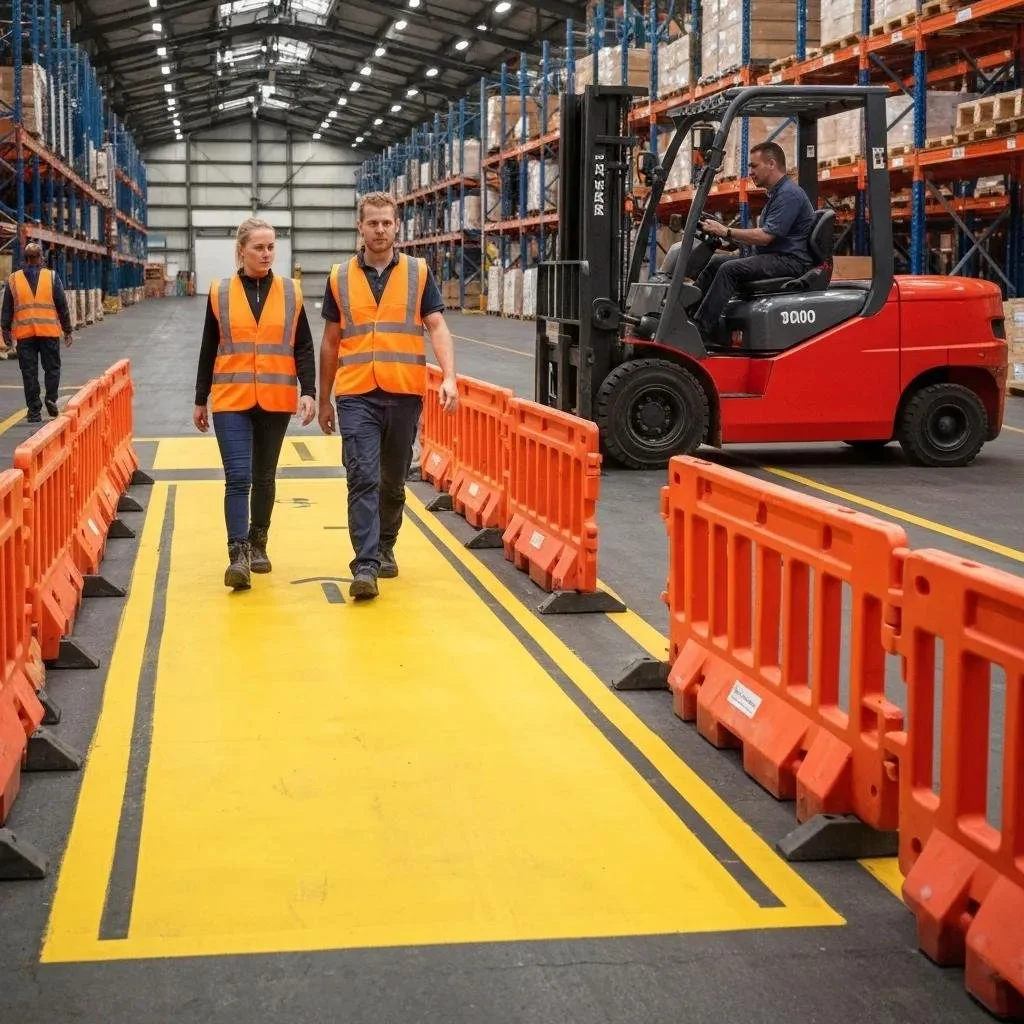
Best practices for pedestrian safety combine physical design, administrative rules and PPE to reduce interactions between pedestrians and forklifts; segregating routes and enforcing exclusion zones are central to preventing collisions. Design measures include clearly marked pedestrian walkways, raised barriers, and dedicated crossings with priority rules; administrative measures include scheduling movements to reduce peak crossing points, using spotters and running awareness training for non-operators. PPE such as high-visibility clothing and protective footwear increases pedestrian conspicuity and reduces injury severity if an incident occurs. The following subsections describe design principles for exclusion zones and the recommended PPE for both pedestrians and operators.
A layered approach to pedestrian protection reduces the opportunity for dangerous encounters and supports consistent enforcement of site rules.
How Do Pedestrian Exclusion Zones and Traffic Management Improve Safety?
Pedestrian exclusion zones and traffic management improve safety by physically or visually separating people from vehicles and by creating predictable flows that reduce surprise interactions; clear routes and barriers reduce collision risk. Practical design principles include defining one-way vehicle lanes, creating raised walkways or barriers, using painted markings and signage to indicate pedestrian priority, and ensuring adequate lighting and sightlines at crossings. Regular audits of traffic patterns and enforcement rounds help identify pinch points and behavioural non-compliance that require redesign or additional controls. Training both drivers and pedestrians in the rules for crossing points and defined paths ensures expectations are shared and understood.
High-visibility clothing: improves visibility in dynamic loading areas.
Physical barriers: permanently separate pedestrian routes from vehicle lanes.
Signage and markings: communicate rules and crossing points clearly.
Effective traffic management turns spatial design into operational practice, which is reinforced by appropriate PPE for maximum protection.
What Personal Protective Equipment Should Pedestrians and Operators Use?
Recommended PPE differs by role but shares the common goal of reducing injury and increasing visibility; pedestrians and operators should use PPE appropriate to the tasks and environment to mitigate impact and improve detection. Pedestrians in operational areas should wear high-visibility vests or shirts, protective footwear with toe protection and consider helmets in yards with overhead risks; these items reduce harm and improve the ability of operators to see people. Operators should also wear high-visibility clothing and protective footwear, and use seatbelts and harnesses where provided by the vehicle design; enclosed-cab options provide additional protection in some contexts. Ensure PPE is maintained, fits correctly and is enforced through site rules and inductions to maximise effectiveness.
Combining PPE with exclusion zones and traffic management reduces both the chance of contact and the severity of outcomes if contact does occur.
What Australian Forklift Safety Regulations Must Employers and Operators Follow?
Australian WHS regulations and SafeWork NSW guidance require employers to identify hazards, implement controls, provide training and maintain equipment; these legal duties ensure workplaces take reasonable steps to prevent incidents involving forklifts. Employers must manage the risk of plant and vehicles, provide information, instruction and training, maintain equipment and keep records of inspections and training.
Understanding these duties helps workplaces design systems, training, inspection regimes and maintenance schedules, that demonstrate compliance and prioritise worker safety.
Introduction to regulatory table: this table summarises relevant WHS and SafeWork NSW documents and the core employer duties they emphasise, providing a quick reference for compliance planning.
| Regulation / Guidance | Jurisdiction | Key requirement / Employer duty |
|---|---|---|
| Model WHS Act & Regs | Australia (national model) | Manage risks, provide training, ensure safe systems of work |
| SafeWork NSW Codes of Practice | NSW | Practical steps for plant safety, risk assessment and operator controls |
| WHS Code: Managing the Risk of Plant | Australia | Ensure plant is safe, maintained and inspected; provide operator instruction |
| Record-keeping expectations | Australia | Keep training, inspection and maintenance records to demonstrate compliance |
This summary table clarifies the core obligations workplaces must meet across Australian jurisdictions and emphasises the importance of documented systems for training and maintenance.
What Are the Key SafeWork NSW Codes of Practice for Forklift Operation?
Key SafeWork NSW guidance documents and codes of practice for forklifts focus on plant safety, risk management, training and systems of work that reduce risk in material handling operations; employers should consult the relevant codes when drafting their site procedures. These documents cover safe work with plants, managing the risk of falls, manual handling considerations, and the practical implementation of traffic management and exclusion zones in workplaces. They explain steps for hazard identification, assessment and control, and provide examples of control measures such as guarding, exclusion zones and maintenance regimes. Employers should use these codes to inform site-specific safe systems of work and to structure training and inspection templates.
Applying the practical recommendations from SafeWork NSW guides helps translate legal duties into concrete actions that reduce forklift-related incidents.
What Are Employer and Employee Duties Under WHS Legislation?
Employer duties under WHS legislation are to provide safe systems of work, suitable training, supervision and maintenance of plant; employees must follow instructions, use PPE and report hazards to enable risk control. Employers should implement documented training and assessment, conduct risk assessments, maintain equipment according to manufacturer guidance and inspection schedules, and keep records demonstrating these actions. Employees are responsible for following site rules, completing pre-start checks, using safety devices like seatbelts and reporting defects promptly. Practical compliance examples include maintaining inspection logs, scheduling preventative maintenance, auditing traffic management plans and recording training and refresher activities.
Employer actions: Provide training, establish safe systems of work, maintain equipment and keep records.
Employee actions: Complete inspections, follow procedures, use PPE and report hazards.
Practical examples: Inspection logs, scheduled servicing, traffic audits and documented training records.
These duties form the legal backbone of a safe forklift operation program and must be embedded in everyday practice to be effective.