Written By : Darko
Buying a used forklift requires more than a quick visual check; it demands a structured inspection, verification of service history, and practical budgeting to reduce risk and long-term costs. This guide explains what to look for when buying a used forklift, from visual wear points and power-source diagnostics to interpreting hour-meter readings and evaluating dealer transparency. Readers will learn a comprehensive inspection checklist, stepwise methods to assess batteries and engines, and how to weigh financing and after-sales support to protect operations. Practical sections cover safety and test-drive protocols, plus a comparison of electric, diesel and petrol models tailored to typical warehouse and outdoor uses. Use these steps and checklists to make confident purchases that balance upfront savings with predictable operating costs.
Why Should You Consider Buying a Used Forklift?
A used forklift is pre-owned material handling equipment that delivers immediate capacity with a lower purchase price and reduced depreciation compared with new units. Buying used works because many forklifts are replaced for fleet optimisation rather than end-of-life, so a well-maintained machine can continue delivering reliable service; the result is faster availability and improved return on investment. For businesses with predictable, single-shift workloads or seasonal demand, pre-owned forklifts often meet capacity needs without the capital outlay of new equipment, making them an efficient choice. The next section breaks these high-level benefits into concrete buyer considerations and cost comparisons to help you decide when used is the right option.
What Are the Key Benefits of Purchasing a Pre-Owned Forklift?
This subsection lists primary advantages to show practical value when choosing a used forklift.
-
Lower Purchase Price: You pay significantly less up front than for new inventory, preserving working capital for operations.
-
Reduced Early Depreciation: Most depreciation already occurred; resale value is more stable over the short term.
-
Faster Availability: Used units are often available immediately, avoiding new-build lead times.
These benefits translate into operational flexibility for businesses that prioritise cash flow and immediate capacity, and they lead naturally to a cost comparison that clarifies total savings.
How Does Buying Used Forklifts Save Your Business Money?
Understanding where the savings come from helps you compare total cost of ownership rather than just sticker price. Typical savings come from a lower initial outlay, reduced depreciation in the first two to three years, and the ability to delay major capital expenditure, which can improve cash flow and financing terms. When comparing offers, include insurance premiums, expected maintenance, potential battery replacement for electrics, and projected fuel or energy costs to compute a realistic two- to three-year cost picture. A short numeric example helps: if a new unit costs 100% and a comparable used unit is priced at 60–70%, even with slightly higher maintenance the total cost over two years often remains lower for the used option. Use this framework to balance immediate savings against projected operating expenses.
An Analysis of Forklift Utilisation, Costs, and Life Cycle for Commercial Enterprises
Forklifts are classified as indispensable equipment within manufacturing and warehousing operations, contributing a significant proportion to the overall operational expenditure of such facilities. Industry surveys indicate that 94% of materials handling businesses lack accurate records of their forklift fleets. Inflated costs are commonly incurred due to insufficient knowledge or limited insight into the true drivers of forklift operating expenses, maintenance requirements, life cycle, and efficient utilisation.
Study on efficient forklift utilisation, cost & life cycle analysis, 2013
What To Check When Buying a Used Forklift: The Comprehensive Inspection Checklist
A structured inspection checklist helps you prioritise critical systems and reduce buying risk by focusing on wear points, safety systems and power-source integrity. Start with a visual sweep, then move to power-system tests, hydraulic checks and an operational test under load; each step confirms whether documented history matches observed conditions. Use the checklist to generate targeted questions for the seller and to decide whether to involve a certified mechanic for a compression or battery load test. Below are visual inspection priorities and a quick reference table that summarises acceptable wear limits and pass/fail cues for common components.
The following quick-reference table helps buyers interpret visible wear on major components during the first visual sweep.
This table focuses inspection priorities so you can quickly eliminate unsafe or heavily worn units before deeper testing. Next, learn how to perform focused visual checks that reveal hidden issues.
How Do You Visually Inspect Forklift Components Like Forks, Mast, and Tires?
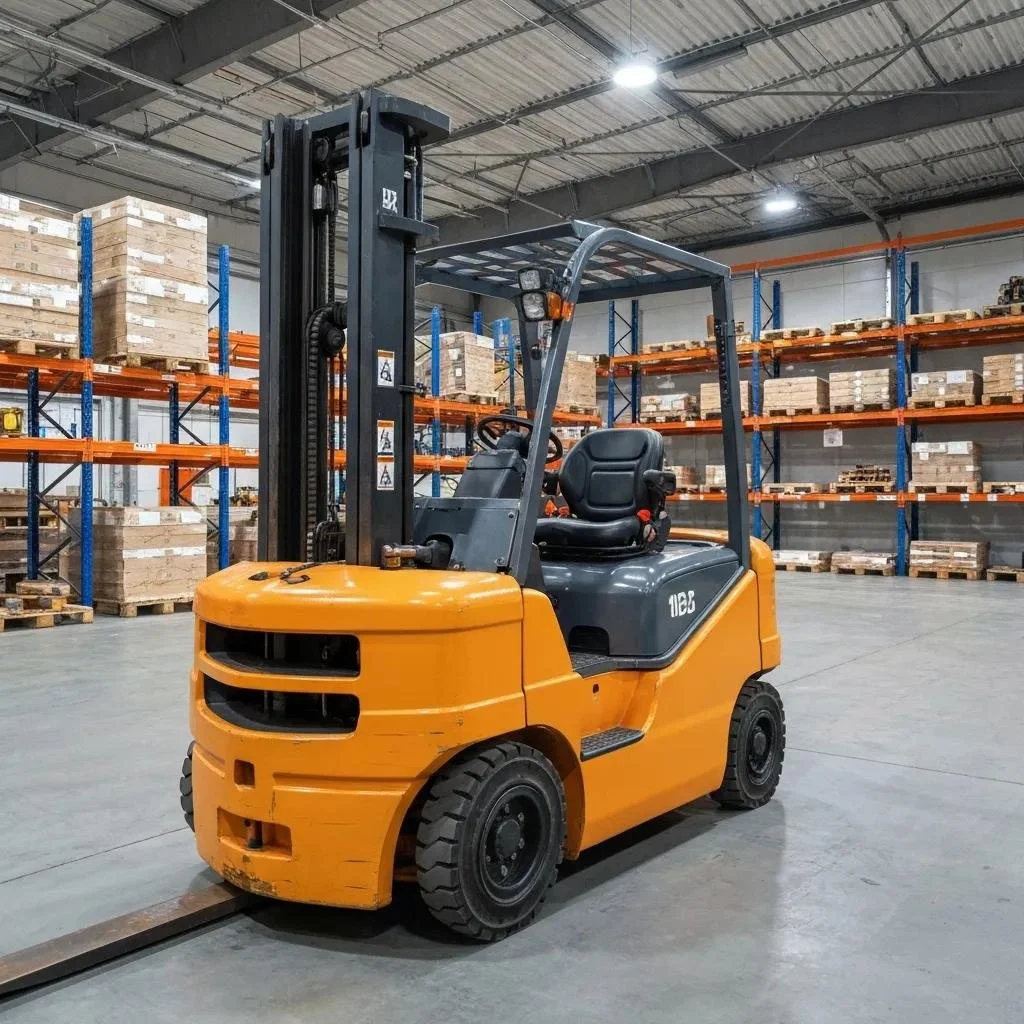
Visual inspection means looking for structural integrity, uneven wear, and signs of poor maintenance that predict future costs. Check forks for heel wear (measure thickness relative to original spec), inspect fork heels and tips for cracks or weld repairs, and ensure forks sit square in the carriage; cracked or welded forks are a safety hazard. Inspect the mast for straightness by sighting up the mast faces and checking roller movement; worn rollers or chain stretch often show as uneven mast travel and require service. Examine tyres for sidewall cuts, cord exposure or mismatched tyre types between axles, because tyre condition affects stability and operating cost. These visual checks set the stage for power-source testing and hydraulic inspections that follow.
What Should You Look for in the Engine, Battery, and Power Source?
Power-source checks differ by hyponym, used electric forklift versus diesel or petrol models, but the goal is the same: confirm that the source delivers rated performance without hidden defects. For electric units, look at battery age, visible terminal corrosion, and ask for recent capacity or load-test results; a failing battery can be the single most expensive replacement item. For petrol and diesel engines, note start-up behaviour, smoke on startup or under load, oil condition and signs of leaks, and listen for abnormal noises that indicate internal wear. Request records of major service items such as filter and fluid changes, and if possible perform a brief loaded run to check steady-state performance. These tests indicate whether immediate repairs are likely and help you price expected near-term maintenance.
How Can You Evaluate the Operational History and Maintenance of a Used Forklift?
Operational history and maintenance records reveal how the forklift was used and whether the owner followed scheduled servicing, which is a stronger predictor of longevity than hours alone. A complete service history with regular intervals, documented component replacements, and notes on repairs suggests consistent upkeep; the result is reduced risk of unexpected failures. Conversely, inconsistent records, long gaps between services, or missing documentation are red flags that require deeper inspection or conservative pricing. Below is a concise table to help interpret common entries in service records and map them to buyer actions.
Review this table to translate service-record entries into buyer implications and next steps.
Use these interpretations to form negotiating points and to prioritise additional tests; next we cover how to interpret hour meters and usage context in practice.
Why Is Reviewing Service Records and Maintenance History Crucial?
Service records connect observed conditions to documented work and reveal maintenance culture; they matter because a well-maintained machine often outlasts a higher-hour but neglected unit. Look for documented intervals for oil, filter and hydraulic fluid changes, plus records of component swaps like forks, rollers or battery replacements. Where receipts or workshop stamps exist they add credibility; where records are missing, treat the unit as higher risk and budget for a pre-purchase inspection. Regular documentation reduces uncertainty and helps you forecast remaining useful life, which feeds directly into purchase price and financing decisions.
Preventive Maintenance for Forklifts: Inspection Methodologies
Within the oil and gas sector, the transportation of materials and equipment is frequently undertaken using forklifts. Consequently, ensuring the safety and reliability of forklifts is paramount to guarantee
Analysis of preventive maintenance on forklifts with the lifting and transporting instruments inspection method, B Baharudin, 2023
How Do You Interpret Hour Meter Readings and Previous Usage Conditions?
Hour-meter values are meaningful only when put in context of operating intensity and environment. Compare hours to typical duty cycles: a single-shift warehouse truck will accumulate far fewer meaningful hours than a multi-shift outdoor loader; similarly, coastal or cold-storage use accelerates corrosion and wear. Reconcile hours with service records, low hours but frequent major repairs or signs of heavy wear is a red flag; conversely, higher hours with consistent servicing can indicate a dependable machine. Use these interpretations to estimate remaining life and maintenance reserves, and to decide whether to request an independent mechanical inspection.
How Do You Choose a Reputable Dealer for Buying Used Forklifts?
Choosing a reputable dealer reduces post-purchase risk by providing transparent records, reconditioning standards and local after-sales support such as maintenance and parts access. Prioritise dealers who offer documented service histories, clear reconditioning descriptions, parts availability and accessible maintenance support in your region; these attributes shorten downtime and simplify warranty resolution if offered. For Illawarra buyers, local support is especially important because response times and knowledge of regional conditions (outdoor coastal exposure, warehouse layouts) influence long-term reliability. The next subsection presents a brief, factual example of a local supplier that illustrates the attributes to seek when selecting a trusted dealer.
What Makes Wollongong Forklift a Trusted Supplier in the Illawarra Region?
Wollongong Forklift operates as an independent, Australian-owned forklift dealer and rental service based in Albion Park, NSW, serving the Illawarra region. The company offers a comprehensive range of new and used forklifts across petrol, diesel and electric power types, plus telehandlers, walkie stackers and pallet trucks, which provides buyers with multiple options for matching capacity and duty cycle. Wollongong Forklift also provides after-sales support including maintenance and repairs and promotes tailored sales solutions and flexible financing, demonstrating the dealer attributes buyers should prioritise: local parts support, transparent reconditioning and accessible service capability. Verify these capabilities by asking any prospective dealer for specific examples of reconditioning work, parts availability and local maintenance arrangements.
What Financing Options Are Available for Purchasing Used Forklifts?
Financing can reduce upfront cost and align payments with the asset’s income generation; common options include lease arrangements, hire purchase and chattel mortgages, each with different ownership and tax implications. When comparing finance offers focus on total cost: interest rate, term length, residuals and any fees or balloon payments, because a lower monthly payment can hide higher total interest. Some local dealers offer flexible financing to help buyers manage cash flow; if a dealer mentions flexible financing, request clear loan illustrations and compare them to independent finance quotes. Always compare the full repayment schedule and how it aligns with expected forklift useful life to ensure financing does not outlast the operational value of the asset.
What Are the Essential Safety Features and Test Drive Tips When Buying a Used Forklift?

Safety checks and a structured test drive are essential to reveal operational faults that visual inspection alone cannot show; they validate brakes, steering, hydraulic response and load handling under simulated duty. Confirm that brakes are responsive and free of unusual noises, that horn and warning lights function, and that seatbelts and operator restraints are intact; these systems protect operators and are often non-negotiable for purchase. A measured test drive sequence, idle checks, no-load manoeuvres, loaded lift tests and a longer operational run, exposes vibration, smoke, slipping or hydraulic hesitation that indicate immediate repair needs. Below is a compact checklist you can follow during a test drive to ensure consistent evaluation.
This checklist summarises the test-drive sequence to use when evaluating operability.
-
Idle and Start-Up: Listen for abnormal noises and observe smoke.
-
No-Load Manoeuvre: Check steering, brakes and transmission response.
-
Loaded Lift and Travel: Test mast operation under rated load and look for slow or jerky movement.
-
Extended Run: Operate for several minutes to identify heat, smoke or fluid leaks.
How Do You Verify Safety Features Like Brakes, Horn, and Seatbelts?
Verifying safety features requires specific pass/fail cues and functional tests rather than impressionistic judgment. Test brakes in a controlled area with and without load; brakes should engage smoothly with no grinding and minimal pedal travel for hydraulic systems. Check the horn and warning lights for clear audibility and visibility, and inspect seatbelts for fraying or locked retractors; non-functional safety equipment is a compliance and liability problem. For hydraulic safety interlocks and mast locks, operate the mast through several cycles and listen for air ingress, cavitation or inconsistent movements. If any core safety system fails, treat the unit as unsafe and either walk away or insist on certified repairs before purchase.
What Should You Observe During a Test Drive of a Used Forklift?
A good test drive follows a scripted sequence to expose performance under realistic conditions and to compare behaviour against expected norms. Start with cold start observations, excessive smoke or rough idle indicate engine or battery issues, then perform no-load directional checks and assess transmission or drive motor smoothness. Next, raise and lower a rated load and observe mast speed, chain noise and any drift when holding position; significant drift or sluggish mast movement points to hydraulic or control problems. Finish with an extended run to check for overheating, leaking fluids or warning lights; these observations inform both negotiation and the need for a professional inspection.
How Do You Assess Different Types of Used Forklifts: Electric, Diesel, and Petrol Models?
Power-source choice affects operating cost, maintenance rhythm and suitability for indoor or outdoor environments; electrics excel indoors with lower emissions, while diesel and petrol variants provide higher continuous power outdoors. Assessment focuses on unique checks for each hyponym: battery lifecycle and charger compatibility for electric forklifts, and compression, smoke and leak diagnostics for combustion engines. Consider the operating environment, indoor, cold-store, coastal, because exposure alters corrosion risk and battery performance. The following table offers direct comparisons of key tests and what to look for to help you choose the right power source for your duty cycle.
Use this comparison to see how battery checks differ from engine checks and what tests to request.
Use this comparison to see how battery checks differ from engine checks and what tests to request.This comparison shows that electrics require battery focus while combustion types need engine diagnostics; next we detail battery and engine checks you can request.
What Are the Key Battery Health Checks for Used Electric Forklifts?
Battery health checks should include reported age and number of charge cycles, visual inspection of terminals and cases, and a professional capacity or load test to measure amp-hour retention. Ask for recent load-test documentation and confirm the charger capacity matches the battery; mismatched chargers shorten battery life. Look for bulging or electrolyte leakage and for heavy corrosion at terminals that indicate poor maintenance; significant deterioration often means costly replacement. If battery replacement is likely, factor that expense into purchase price or negotiation.
What Engine Considerations Should You Know for Petrol and Diesel Forklifts?
Engine checks focus on start-up behaviour, exhaust smoke characteristics, fluid leaks and documented repairs; these signs indicate internal condition and maintenance quality. Black smoke typically signals fuel-rich combustion or injector issues, blue smoke suggests oil burning (worn rings or valve seals), and white smoke can indicate coolant ingress, each has different cost implications. Inspect oil colour and level, look for evidence of head gasket failure, and request compression or leak-down tests when possible to quantify internal wear. Finish by reviewing recent major repairs in service records and, if uncertain, bring a qualified mechanic for a pre-purchase evaluation; this final assessment helps you set a realistic purchase price and reserve budget for repairs or tuning.
For buyers who want local support or inspection services, Wollongong Forklift in Albion Park, NSW, can assist with parts, maintenance and tailored sales solutions and offers flexible financing and after-sales support to help match a used unit to your operations. For an inspection, ask for documented reconditioning notes and a maintenance plan so your purchase includes clear expectations for short-term upkeep. Contact local dealers to arrange a mechanical review or to request recent load and service reports before finalising any purchase.