Forklift Rental Options Near You: Discover the Best Deals on Forklift Hire in Wollongong
Written By : Darko
Finding the right forklift hire in Wollongong means balancing cost, lift capacity and local support to keep projects on schedule and safe. This guide explains how forklift rental companies near me can save capital, provide flexible short-term and long-term options, and deliver specialised equipment for warehouses, construction sites and logistics operations. Readers will learn the benefits of renting versus buying, which forklift types suit different tasks, how rental terms shape hire costs, and how to compare quotes effectively for the Wollongong and Illawarra region. Practical checklists and comparison tables help you request accurate quotes, evaluate inclusions such as maintenance or operators, and decide whether short-term hire or long-term leasing is best for your operation. Where relevant, the article cites local supplier examples, such as Wollongong Forklift, to illustrate tailored rental fleets and flexible financing, details collected below in the supplier section for those seeking a local quote.
What Are the Benefits of Renting a Forklift in Wollongong?
Renting a forklift provides immediate access to appropriate material handling equipment without large capital expenditure, which improves cashflow and lets businesses scale capacity for seasonal peaks. The mechanism is simple: converting a capital purchase (CAPEX) into an operating expense (OPEX) avoids depreciation, ongoing insurance and long-term storage costs while delivering newer, well-maintained machines. Renting also reduces downtime risk because maintenance and breakdown cover are commonly included in hire contracts, so equipment reliability improves operational continuity. These advantages apply across local industries from warehousing to construction, and they position rental as a tactical choice for short projects or fleet top-ups.
Indeed, industry experts often highlight how renting equipment can significantly reduce maintenance burdens and associated costs.
Equipment Rental Benefits: Reduced Costs & Maintenance
typically rents equipment from suppliers near the project. "We feel there are several benefits of renting, but for us the main reason is the reduced cost for maintenance," says Clark.
Renting equipment reduces costs and downtime for SCR retrofit., 2003
Wollongong Forklift is an example of a local independent dealer offering tailored rental solutions, short-term and long-term, so businesses can pair the right machine with competitive pricing and local support; see the dedicated supplier section below for more on those options. Understanding these benefits leads naturally to a closer look at how renting compares to buying in practical cost terms and which hire durations fit different use-cases.
The main benefits of renting forklifts in Wollongong include:
Lower upfront cost: Renting removes large capital outlays and preserves working capital for operations.
Flexibility to scale: Hire lets you increase or decrease fleet size for projects or seasonal demand.
Access to modern equipment: Rentals typically supply newer machines that improve safety and efficiency.
Maintenance and support: Contracts often include servicing, reducing unplanned downtime.
These benefits make rental particularly attractive for businesses facing fluctuating demand or limited storage, and the next section will quantify cost differences to help decide when to rent or buy.
How Does Forklift Rental Save Costs Compared to Buying?
Renting saves costs primarily by avoiding CAPEX, depreciation and long-term ownership expenses, converting purchase costs into predictable rental payments that can match project timelines. The mechanism of savings includes eliminating large initial purchase prices, reducing insurance premiums allocated per asset, and shifting repair bills to the rental provider when maintenance is included. For example, a short project requiring a 2–5 tonne forklift can often be covered by a daily or weekly hire rate that is cheaper than financing purchase plus maintenance for the same period. Local market conditions in Wollongong and the Illawarra affect availability and delivery costs, so calculating total cost of ownership versus total hire cost for typical project lengths is essential.
Academic research further explores the strategic decision-making between purchasing and renting, often framing it within a product service system (PSS) to manage the entire lifecycle.
Rent vs. Buy: Product Service System for Equipment Procurement
The objective of this study is to construct a renting system in a reverse logistics environment on the basis of the PSS theory: this system includes the complete management of product examination, maintenance, upgrading, products recycling, and final waste disposal. Due to the different procurement processes of PSS, the following two product operations are analysed: (1) procurement of new products and (2) rental of products.
Simulation of purchase or rental decision-making based on product service system, TC Kuo, 2011
To decide, compare a three- to six-month rental estimate against financing repayments, expected repair/inspection costs and resale value. This financial comparison highlights when renting is preferable, short projects, seasonal peaks, uncertain demand, and sets up the next discussion on choosing between short-term and long-term hire options.
What Flexibility Do Short-Term and Long-Term Hires Offer?
Short-term hire offers rapid availability, minimal commitment and ideal flexibility for one-off projects, emergency replacements or seasonal surges, while long-term leasing lowers periodic cost and supports predictable operations with maintenance often bundled. The difference in mechanism is contract duration: short-term contracts prioritise availability and speed, whereas long-term leases spread costs over months or years and typically include servicing, parts and scheduled inspections. For example, a retail fit-out lasting a few weeks benefits from day/week hire, whereas logistics operations that need fleet stability will favour monthly or multi-year leasing to secure machines and maintenance coverage.
Decision criteria include project length, cashflow, required uptime and whether you need replacement units included; assessing these leads into practical guidance on contract terms and inclusions to watch for when comparing quote
Which Types of Forklifts Are Available for Rent Near You?
The local rental market typically provides a range of material handling vehicles to match site conditions and tasks, from electric counterbalance forklifts for indoor warehouses to telehandlers for construction sites. Each forklift type fits specific environments because of fuel type, lift capacity and attachment options, and choosing correctly reduces operating risk while improving efficiency. Below is a concise list of common rental types and one-line use-cases to support fast decision-making when searching for "forklift hire Wollongong" or "telehandler rental Wollongong."
Common forklift types available for rent include:
Electric forklift hire: Ideal for indoor warehouses and clean environments.
Diesel forklift hire: Suited for heavy-duty outdoor and rough-terrain tasks.
Telehandler rental: Best for construction sites requiring long reach and varied attachments.
Walkie stacker hire: Compact solution for narrow aisles and light pallet handling.
Pallet truck hire: Low-cost option for moving palletised loads short distances.
Wollongong Forklift maintains a comprehensive new and used fleet covering petrol, diesel and electric forklifts, telehandlers, walkie stackers and pallet trucks as local examples of available options for businesses seeking flexible hire choices. Understanding these types leads into a detailed comparison table to match machine attributes to applications.
| Forklift Type | Ideal Use / Fuel | Typical Capacity | Indoor vs Outdoor |
|---|---|---|---|
| Electric forklift | Indoor warehouses / Electric | 1.5–3.5 t | Indoor |
| Diesel counterbalance | Outdoor heavy-duty / Diesel | 2.5–8 t | Outdoor |
| Telehandler | Construction and lifting / Diesel or petrol | 3–12 t (varies) | Outdoor |
| Walkie stacker | Light pallet handling / Electric | 0.5–2 t | Indoor |
| Pallet truck | Loading/unloading short moves / Electric or manual | 1–2.5 t | Indoor/Outdoor short range |
This table helps narrow choices by capacity and environment, and the next sections explain why electrics suit indoor use and when diesel is preferable for heavy tasks.
What Are the Advantages of Electric Forklift Rental for Indoor Use?
Electric forklifts are zero-emission at point of use, emit less noise and typically have lower operating and maintenance costs, making them well suited for indoor warehousing and retail environments. The mechanism of advantage is battery-powered operation which removes tailpipe emissions and reduces ventilation requirements, improving workplace air quality and safety. Typical capacities for electric models range from 1.5 to 3.5 tonnes for counterbalance units used in narrow aisles and racking operations, with battery charging considerations affecting shift scheduling and charger availability. Operators must plan for charging cycles and possibly swap batteries for multi-shift operations, which rental providers can often support through battery rental or swap services.
Given these benefits, many warehouses favour electric hire for indoor use, and the next subsection will contrast these advantages with diesel machines designed for heavy outdoor work.
When Should You Choose Diesel Forklift Hire for Heavy-Duty Tasks?
Diesel forklifts deliver higher torque, longer range and greater lifting power for heavy loads and rough terrain, making them the right choice for construction sites, quarries and outdoor yards. The mechanism of suitability is the diesel engine's superior power density and fueling convenience on long shifts, which translates into better performance under heavy-duty cycles and in uneven ground conditions. Typical capacities for diesel counterbalance and rough-terrain models extend above 3 tonnes and into specialised telehandler ranges, and operators must account for fuel handling and emissions when planning site operations. Environmental and regulatory considerations apply for outdoor sites, but diesel remains preferred where power and durability outweigh higher running costs.
Understanding how rental terms influence pricing helps make the final cost-effective selection between diesel and electric hires for Wollongong operations.
How Do Rental Terms Affect Forklift Hire Costs in Wollongong?
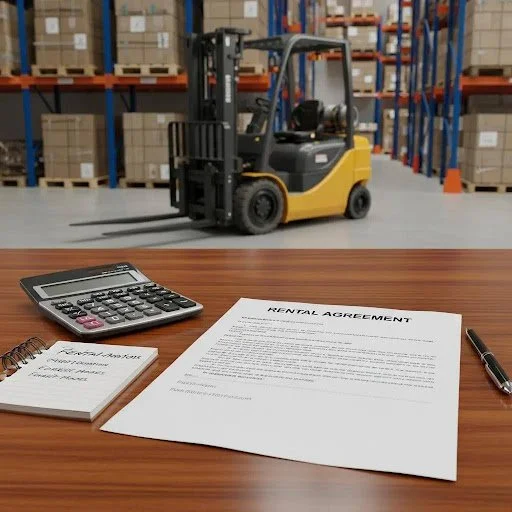
Rental terms such as duration, inclusions, delivery, attachment provision and operator services directly influence hire costs, since each term alters the provider’s servicing and logistical commitments. The mechanism is straightforward: longer contracts usually lower per-day rates while adding inclusions like maintenance or breakdown cover increases the headline rate but reduces total cost of ownership for the renter. Key cost drivers include forklift type, lift capacity, required attachments, distance for delivery and availability of specific models in the Illawarra region. Clear comparison requires requesting itemised quotes that list daily/weekly/monthly rates and any additional fees.
Understanding the full scope of forklift operating expenses, including maintenance and utilisation, is crucial for effective cost management, as highlighted by various studies.
Forklift Cost Analysis: Utilisation, Maintenance & Life Cycle
Inflated costs are usually incurred due to the lack of knowledge or little insight into the true drivers of forklift operating expenses, maintenance, life cycle and efficient utilisation. A comprehensive study on all abovementioned aspects affecting forklifts would prove beneficial in the long run for any business that utilises such a fleet.
Study on efficient forklift utilisation, cost & life cycle analysis, 2013
| Rental Term | Typical Duration / Inclusions | Price Range / Notes |
|---|---|---|
| Short-term hire | Day to week; maintenance optional | Higher daily rates; flexible availability |
| Medium-term hire | Month to quarter; maintenance often included | Lower monthly cost; replacement options |
| Long-term lease | Multi-month to years; servicing included | Lowest periodic cost; fleet stability |
| Rent-to-own | Extended duration with purchase option | Builds equity; higher total cost over time |
This table clarifies how duration and inclusions affect pricing, and the following paragraphs break down local cost factors and a direct short-term vs long-term comparison.
What Factors Influence Forklift Rental Prices Locally?
Local price variation stems from equipment availability, distance and logistics costs, seasonal demand spikes and the need for specialised attachments or operators. The mechanism is that rental providers allocate machines based on proximity and fleet utilisation; longer delivery distances and scarce models increase the effective rate due to transport and opportunity cost. Wollongong and the Illawarra region can experience demand-driven fluctuations from construction peaks or warehousing cycles, so early booking often secures better rates and availability. A practical checklist for quotes includes required capacity, mast height, attachments, delivery location and expected hours of operation.
Key factors that influence local rental prices include:
Model and capacity availability in the region, which affects scarcity premiums.
Delivery and pickup fees for Wollongong/Illawarra, adding to total hire cost.
Seasonal demand and project pipelines that push rates higher during peak periods.
Comparing these factors informs whether to prioritise immediate availability or long-term cost savings when selecting hire terms.
How Do Short-Term Forklift Hire and Long-Term Leasing Compare?
Short-term hire provides flexibility and rapid deployment at a higher per-day price, while long-term leasing offers lower monthly costs and often includes scheduled maintenance and replacement cover. The mechanism of cost differentiation lies in utilisation: short-term rentals fill intermittent needs and carry higher administrative and transport cost per day, whereas leases distribute those costs across longer durations and enable economies of scale for servicing. Pros and cons include immediate availability versus long-term predictability, and the decision hinge points are project length, cashflow constraints and the importance of including maintenance or operator services.
A simple pros/cons list helps decide which option fits your operation:
Short-term hire: Flexible and fast but higher per-day cost.
Long-term leasing: Lower periodic cost and included servicing.
Rent-to-own: Builds equity but typically costs more overall.
Understanding these trade-offs leads into which industries most benefit from each rental approach in Wollongong.
What Industries Benefit Most from Forklift Rental Services in Wollongong?
Forklift rental supports a range of regional industries by matching equipment to task-specific demands without long-term capital commitments; core beneficiaries include construction, warehousing, logistics, manufacturing and retail. The mechanism is capability matching, rentals allow businesses to secure the right lift capacity, attachments and mobility for each job, which reduces downtime and improves throughput. For example, construction projects often need telehandlers and rough-terrain units for temporary heavy lifting, while warehouses prioritise electric forklifts and walkie stackers for sustained indoor operations. The following list maps primary industries to typical rental priorities.
Industries and their common rental priorities:
Construction: Reach, rough-terrain capability and telehandlers for varied lifts.
Warehousing: Electric counterbalance forklifts and walkie stackers for racking operations.
Logistics: Fleet scaling, telematics options and long-term leasing for stability.
Retail and small business: Compact pallet trucks and weekend hire for back-of-store tasks.
Mapping these industry needs helps identify which rental terms and machine types to request in quotes, and the next subsections provide use-case specifics for construction, warehousing, logistics and retail.
How Is Forklift Hire Used in Construction and Warehousing?
In construction, telehandlers and rough-terrain forklifts handle uneven ground, long reaches and heavy loads, while in warehousing electric forklifts, pallet trucks and walkie stackers optimise indoor efficiency and racking access. The mechanism of application is task alignment: each environment demands machines with appropriate lift capacity, mast height and attachments, and rental avoids under- or over-investing in equipment that’s only occasionally needed. Safety and site-specific compliance matter, providers commonly supply machines that meet inspection standards and can advise on operator requirements. Knowing which machines match the task reduces risk and improves project timelines.
This practical mapping then extends to logistics and retail businesses, where scale and compactness drive different rental choices.
What Solutions Are Available for Logistics and Retail Businesses?
Logistics operations often require long-term leasing, fleet scaling options and telematics to track utilisation, whereas retail businesses favour compact forklifts, walkie stackers and short-term top-up hires for busy seasons. The mechanism is operational fit: logistics needs predictable uptime and data-driven fleet management, while retail prioritises manoeuvrability and minimal storage footprint. Rental packages can include operator provision, scheduled servicing, or weekend-only hire to match seasonal demands. For small businesses, short-term hire offers a low-risk way to meet temporary demand without investing in storage or maintenance infrastructure.
Why Choose Wollongong Forklift for Your Forklift Rental Needs?
Wollongong Forklift is an independent Australian-owned forklift dealer and rental service serving Wollongong and surrounding Illawarra areas, offering forklift rental and hire including petrol, diesel and electric forklifts, telehandlers, walkie stackers and pallet trucks. Their value proposition emphasises tailored rental solutions for both short-term and long-term needs, competitive pricing with flexible financing options and a comprehensive new and used fleet that matches varied industry requirements. Local expertise and customer support are core strengths for on-site delivery, maintenance and rapid response to breakdowns, which matters when uptime affects project timelines and productivity.
What Local Expertise and Customer Support Does Wollongong Forklift Provide?
Wollongong Forklift leverages local knowledge of Wollongong and the Illawarra region to match machines to site conditions, offering on-the-ground delivery and responsive maintenance support as part of rental arrangements. Their approach emphasises tailored quotes that reflect delivery distance, required attachments and expected hours to give accurate pricing for short-term and long-term hire. While exact response times are not listed here, the company positions itself as a local partner for businesses needing fleet flexibility and practical advice on machine selection. Requesting a detailed quote that specifies capacity, mast height and inclusions will help evaluate their offerings
How Does Wollongong Forklift Ensure Quality and Maintenance?
Fleet quality is maintained through routine servicing and inspection schedules, provision of replacement units or breakdown cover and quality checks for used equipment before it is offered for hire. The mechanism is preventive maintenance: scheduled inspections reduce the likelihood of in-service failures and ensure that safety-critical items like brakes and hydraulics meet regulatory expectations. Wollongong Forklift's rental options include machines across fuel types and configurations, and maintenance-included rentals help clients avoid unexpected repair costs and downtime. Verifying what maintenance and replacement provisions are in a quote ensures the hire delivers predictable uptime.
Where Can You Find the Best Forklift Rental Deals Near You?
Finding the best deals requires structured requests, early booking and clear comparison of total cost and inclusions rather than headline daily rates, since hidden fees often change the effective price. The practical approach is three-fold: prepare an accurate specification, request itemised quotes from multiple suppliers, and compare inclusions such as delivery, insurance, operator provision and maintenance. Below is an offers comparison table to make it easy to understand what to ask for and how offers typically differ between vendors.
| Offer Type | What It Includes | Example Benefits |
|---|---|---|
| Basic day/week hire | Machine only; delivery optional | Good for short projects; higher per-day cost |
| Maintenance-included package | Servicing and breakdown cover | Reduces downtime risk and unexpected costs |
| Fleet lease | Long-term machine supply and servicing | Lower periodic cost and operational predictability |
| Operator-included hire | Machine plus certified operator | Simplifies compliance and immediate deployment |
Use this table to identify which offer type aligns with your needs, and then follow the step-by-step template below to request accurate quotes that are comparable across suppliers.
To request quotes effectively, provide the following information:
Specify operational dates and expected daily hours so providers can estimate utilisation accurately.
State required lift capacity, mast height and any attachments to ensure correct model selection.
Include delivery location details and whether an operator or maintenance package is required.
Providing these details produces more accurate quotes and enables apples-to-apples comparisons, which leads into the final FAQ-style clarifications below.
How to Request a Quote and Compare Rental Options in Wollongong?
When requesting a quote, supply exact machine specifications, duration, expected hours per day and any site restrictions to ensure vendors return comparable offers. The mechanism is transparency: the more precise your request, the more accurate the delivered quote will be regarding daily rates, delivery fees and maintenance inclusions. Ask each vendor to itemise transport, insurance, maintenance and operator fees, and request options for short-term versus long-term pricing to see the cost curve. Comparing total cost of hire rather than the headline daily rate prevents surprises at invoice time and makes trade-offs between flexibility and price clearer.
With accurate quotes in hand, you can evaluate which supplier provides the right balance of rate, inclusions and local support for Wollongong operations.
What Are Common FAQs About Forklift Rental Services?
Common questions focus on cost ranges, what is included in standard hire contracts, operator availability and whether maintenance is covered, and the direct answers help set expectations for procurement. Typical cost ranges depend on machine type and duration, with electric warehouse forklifts usually cheaper per day than heavy-duty diesel machines, and long-term leases offering the lowest periodic cost. Rental contracts commonly include basic servicing and optional breakdown cover; operators may be provided for an additional fee or included as part of a package. Understanding these points helps you ask the right questions when comparing offers.
These FAQs close the guide and the next practical step is assembling your quote request using the templates and checklists provided earlier to secure the best local hire deal.